
-

- Ducted vs. Ductless Range Hoods: What Ontario Homeowners Need to Know About Makeup Air
Ducted vs. Ductless Range Hoods: What Ontario Homeowners Need to Know About Makeup Air

Ducted or ductless is usually the first real decision in a kitchen ventilation plan, and it’s the one homeowners tend to make last — after the cabinets are drawn, the range is chosen, and the hood has already been designed into the elevation. That’s backwards, because the answer changes what’s possible on the wall.
It also has a second half that almost nobody sees coming: makeup air. If you’re putting a powerful hood into a modern, well-sealed home in the GTA, there’s a good chance your ventilation plan needs a fresh air supply to go with it — and finding that out at inspection is an expensive way to learn.
Here’s how the two systems actually differ, and what Ontario homeowners need to know before signing off on a hood.
Ducted vs. Ductless: The Short Version
A ducted hood pulls air off the cooktop and exhausts it outside through rigid metal duct, exiting through the roof or an exterior wall. Grease, steam, smoke, heat, odours and combustion byproducts all leave the building.
A ductless hood — also called recirculating, ventless, or non-vented — pulls the same air through a grease filter and then a charcoal filter, and blows it back into the kitchen. Nothing leaves the house.
| Factor | Ducted | Ductless |
|---|---|---|
| Removes grease | Yes, exhausted outside | Partially, trapped in filters |
| Removes heat & humidity | Yes | No |
| Removes odours | Yes | Reduces them; charcoal fades over time |
| Ongoing cost | Filter cleaning only | Charcoal filter replacements, typically every few months |
| Installation | Requires an exterior duct route | Plug in and go |
| Noise at equal capture | Lower, especially with a remote blower | Higher, air is forced through dense filters |
| Makeup air considerations | Applies above certain exhaust rates | None, no air leaves the home |
Should I Get a Ducted or Ductless Range Hood?
If you can duct, duct. There isn’t a serious performance argument for recirculating when an exterior route exists. A ducted hood removes the heat and moisture that a ductless hood physically cannot, and moisture is the one people underestimate — it’s what fogs windows, swells cabinet doors over time, and settles as a film on upper cabinets and crown moulding.
Ductless makes sense in a narrow set of situations: a condo or apartment where the building doesn’t permit an exterior penetration, an island or peninsula where the ceiling can’t be opened up, a heritage property with restrictions, or a secondary kitchen and basement suite where cooking is light. In those cases a good recirculating hood is far better than no hood at all.
The middle ground worth knowing about: many quality hoods are convertible. They ship ducted-ready and accept a recirculating kit, so you can install ductless now and convert later if a renovation opens up a duct path. If there’s any chance of a future addition or reroute, buy convertible.
Do Ductless Range Hoods Actually Work?
They work, but not at the job most people think they’re buying. A recirculating hood with clean filters will meaningfully reduce airborne grease and cooking odours in the room. That’s real, and it’s better than the open kitchen with nothing running.
What it will not do is remove heat, steam or combustion byproducts, because that air never leaves the room. On a gas range in particular, that matters — the moisture and byproducts from combustion stay inside the house. Performance also degrades on a schedule. Charcoal saturates, and a hood running on spent filters is doing very little beyond making noise.
So the honest answer is that a ductless hood handles smell and some grease, and nothing else. Judge it on that basis and you won’t be disappointed.
What Are the Disadvantages of Ventless Hoods?
- No heat or humidity removal. Steam, and the moisture from gas combustion, stays in the kitchen.
- Ongoing filter cost. Charcoal filters are consumable and need replacing on a regular cycle, typically every three to six months with normal cooking.
- Declining performance. Effectiveness drops steadily between filter changes, and most people change them late.
- Noise. Pushing air through dense charcoal is harder work, so recirculating hoods often run louder for less real capture.
- Grease redeposits. Whatever the filters miss lands back in the room — cabinets, ceiling, paint.
- Weak fit for high-BTU cooking. If you’ve bought a professional range, ventless will undersell it badly.
- Resale perception. In the GTA market, buyers looking at a high-end kitchen expect properly vented ventilation.
Can I Replace a Ducted Range Hood With a Ductless One?
Usually yes, but it’s rarely a good trade. Physically, you can install a recirculating hood in place of a ducted one and cap the existing duct — and it’s worth capping it properly, because an abandoned open duct becomes an uninsulated hole to the outdoors and a path for cold air, moisture and pests.
The question is why you’d want to. If the existing duct run is undersized, badly routed, or full of flexible duct, the better fix is almost always to correct the ductwork rather than abandon it. You already have the hardest part — an exterior penetration — and giving it up is difficult to reverse later.
The cases where the swap is genuinely reasonable: a condo board or landlord no longer permits the exterior vent, the duct passes through space being reclaimed in a renovation, or the run has failed and rerouting isn’t feasible within the structure. Otherwise, repair the duct.
Makeup Air: The Part Nobody Mentions Until Permit Stage

Here’s where ducted ventilation gets more involved than a hood spec sheet suggests.
When a hood exhausts air outside, that air has to be replaced. In an older, leaky house it seeps in around windows, doors and framing without anyone noticing. In a modern, well-sealed home — which describes most new builds and most gut renovations across Toronto and the GTA — there aren’t enough leaks to keep up. The house goes into negative pressure and starts pulling replacement air from wherever it can find it.
That includes the wrong places: down a chimney, back through a water heater or furnace flue, or up through plumbing traps. Backdrafting combustion appliances is a carbon monoxide risk, and it’s precisely why the codes address this at all. Even short of that, a depressurized house makes the hood itself perform poorly — the blower is fighting a vacuum, so you get less capture than the CFM rating promises.
A makeup air system solves it by bringing in outdoor air at roughly the rate the hood exhausts, through a dedicated duct with a motorized damper that opens automatically when the hood turns on. In our climate that air usually needs tempering, so it’s coordinated with the HVAC system rather than bolted on.
What Does Ontario’s Building Code Say About Makeup Air?
You’ll often see 400 CFM quoted online as the point at which makeup air becomes mandatory. That figure comes from US model-code requirements and should not be treated as the Ontario rule.
Ontario’s Building Code addresses makeup air through its protection-against-depressurization requirements. Whether those requirements apply depends on the home’s exhaust equipment and whether it contains fuel-fired space- or water-heating appliances that are not direct-vented or mechanically vented. Testing and other exceptions may also affect what is required.
For a GTA renovation, any high-capacity hood should be reviewed early—especially in a tightly sealed home or one with naturally drafted fuel-fired equipment. An all-electric home or a home with direct-vented mechanical equipment may be treated differently. Confirm the final requirements with the HVAC designer and local building department before ordering the hood.
Why this changes the appliance you choose
The practical consequence is that CFM isn’t free. Specifying a 1,200 CFM blower because bigger sounds better can commit you to a makeup air unit, additional ductwork, an exterior intake, and coordination with the furnace — real money, and real space in the mechanical plan.
Right-sizing is the smarter move. Match the hood to the cooking, and use a wide fan-speed range so you’re not running full power to simmer a pot. Some high-end hoods also allow the blower to be calibrated to a set maximum CFM at commissioning, which is a legitimate way to reduce exhaust capacity without giving up hood size or looks.
If You’re Ducting, Do It Properly
A ducted hood is only as good as its duct. The recurring problems we see in GTA kitchens are the same few every time:
- Flexible duct. The ribbed interior kills airflow and traps grease. Use smooth rigid metal.
- Undersized duct. A 6-inch round line choking a blower that needs 8 or 10 inches. The hood will be loud and weak, and the spec sheet will look fine.
- Too many elbows. Every bend costs airflow. Shortest, straightest route wins.
- No insulation through unconditioned space. Warm, humid exhaust hitting cold duct in an attic means condensation.
- A cheap termination cap. Undersized or screened caps restrict flow and freeze shut in winter. Use a proper damper cap sized to the duct.
Where the duct run is long or the hood is powerful, a remote or in-line blower is worth specifying. Moving the motor to the attic or an exterior wall drops kitchen noise substantially, which is the single most common complaint about high-CFM hoods.
Which Is Right for Your Kitchen?
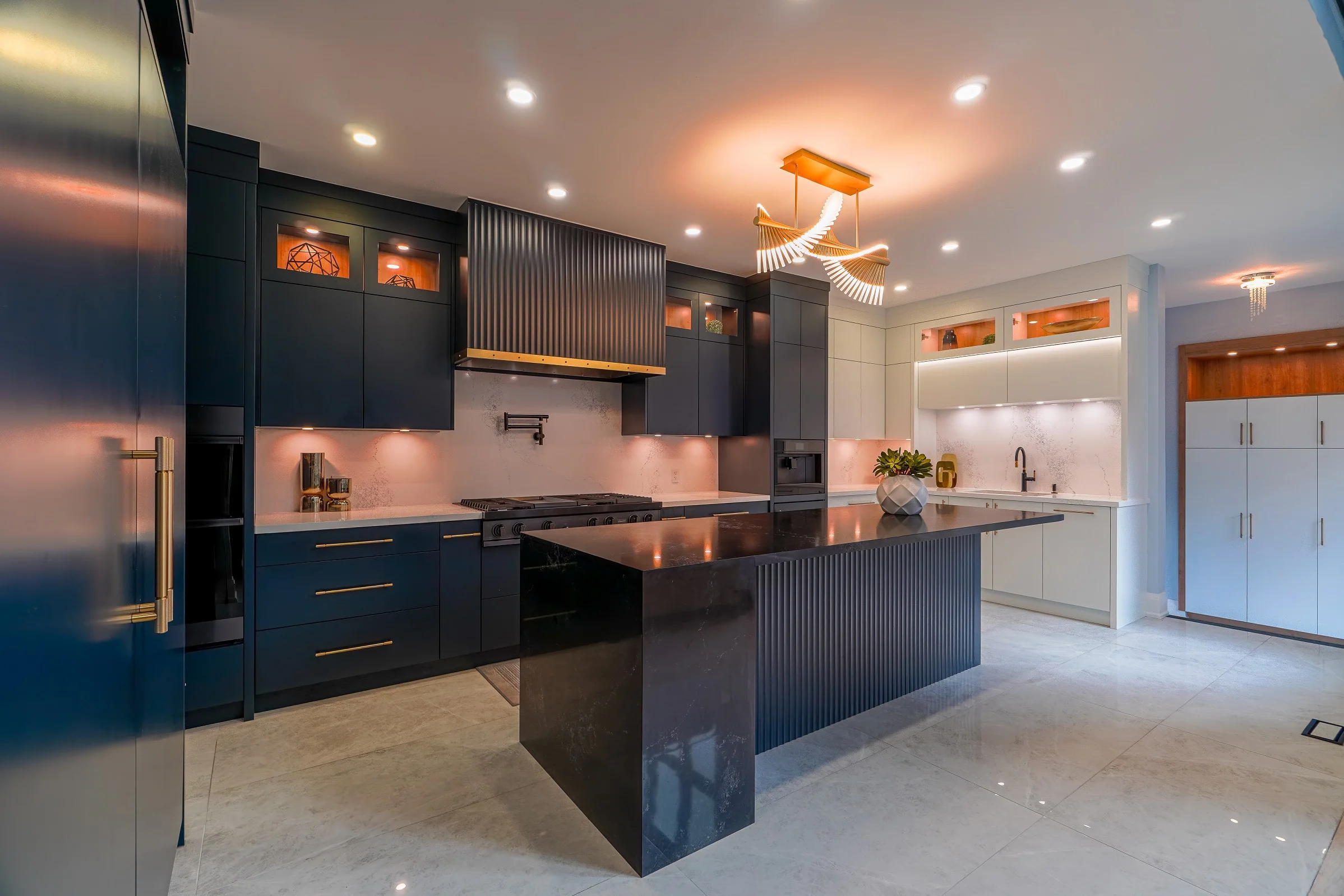
Choose ducted if there’s any workable route to the outside. It’s the right answer for gas ranges, for high-BTU cooking, for open-concept layouts where cooking smells travel, and for any kitchen you’re investing real money in.
Choose ductless when the building genuinely won’t allow an exterior vent — condo units, certain island and interior-wall positions, secondary suites — and buy a convertible model so the option stays open.
Plan makeup air early if you’re going ducted with a powerful hood in a newer or recently sealed home. It belongs in the mechanical drawings, not in a change order.
Layout drives a lot of this too. Wall positions are the easiest to duct, which is why wall-mounted range hoods are the most straightforward install. Island range hoods need a ceiling route and more capture power, since there are no side walls containing the plume. Downdraft systems solve sightline problems where an overhead canopy isn’t wanted, with a trade-off in capture.
Ventilation Planning at Castle Kitchens
We handle the cabinetry, the appliances and the installation, so ventilation gets planned alongside the kitchen rather than after it. That means checking the duct route before anyone orders a hood, flagging makeup air while the mechanical plan is still open, and sizing the blower to how the kitchen will actually be cooked in.
We carry ventilation from Vent-A-Hood, Thermador, Miele, Monogram and La Cornue, among other brands in our showroom. That includes inserts and liners sized for professional ranges, as well as full hoods. You can see the full ventilation range, or browse custom range hoods if the hood needs to be built to the room rather than pulled from a catalogue.
When a canopy has to match your cabinetry, fit an awkward ceiling, or sit between two windows, we design the hood around the room instead of the other way around — see our custom range hoods in Toronto for how that process works, from concept through installation.

Final Thoughts
Ducted versus ductless looks like a preference and is really a constraint — duct if the house lets you, recirculate only when it doesn’t. The part worth catching early is makeup air, because it’s cheap to design in and expensive to retrofit, and it’s the detail most likely to surprise a homeowner halfway through a renovation.
Visit Castle Kitchens in Markham to plan your kitchen ventilation properly, with expert guidance from design through installation across the GTA.


